How to play Gin Rummy
Gin Rummy is a card game for two. You draw and discard to turn your ten cards into sets and runs, and end the hand by knocking when the cards that are left over count 10 points or less. The first player to reach 100 points wins. You play here against the computer.
The goal
Reach 100 points before the computer does. You score in each hand by having less deadwood than the other player: deadwood is every card in your hand that is not part of a set or a run.
Setting up
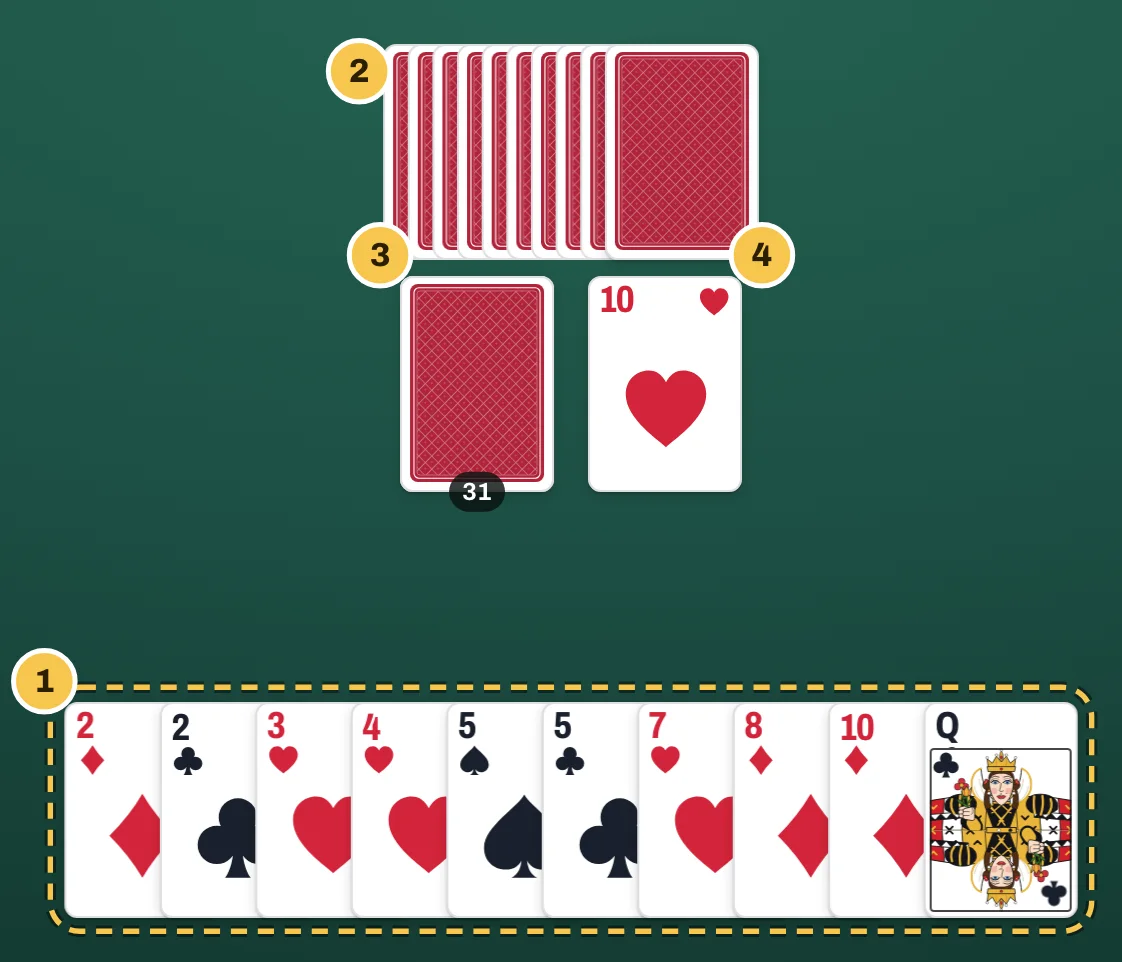
- The deal. Each player gets ten cards. The next card is turned face up to start the discard pile, and the rest of the deck is the stock.
- Your hand is sorted for you. Sets and runs stand together on the left, and your deadwood follows on the right.
- The first turn. The player who did not deal may take the turned-up card or pass. If they pass, the dealer may take it. If both pass, the first player draws from the stock.
Sets, runs and deadwood
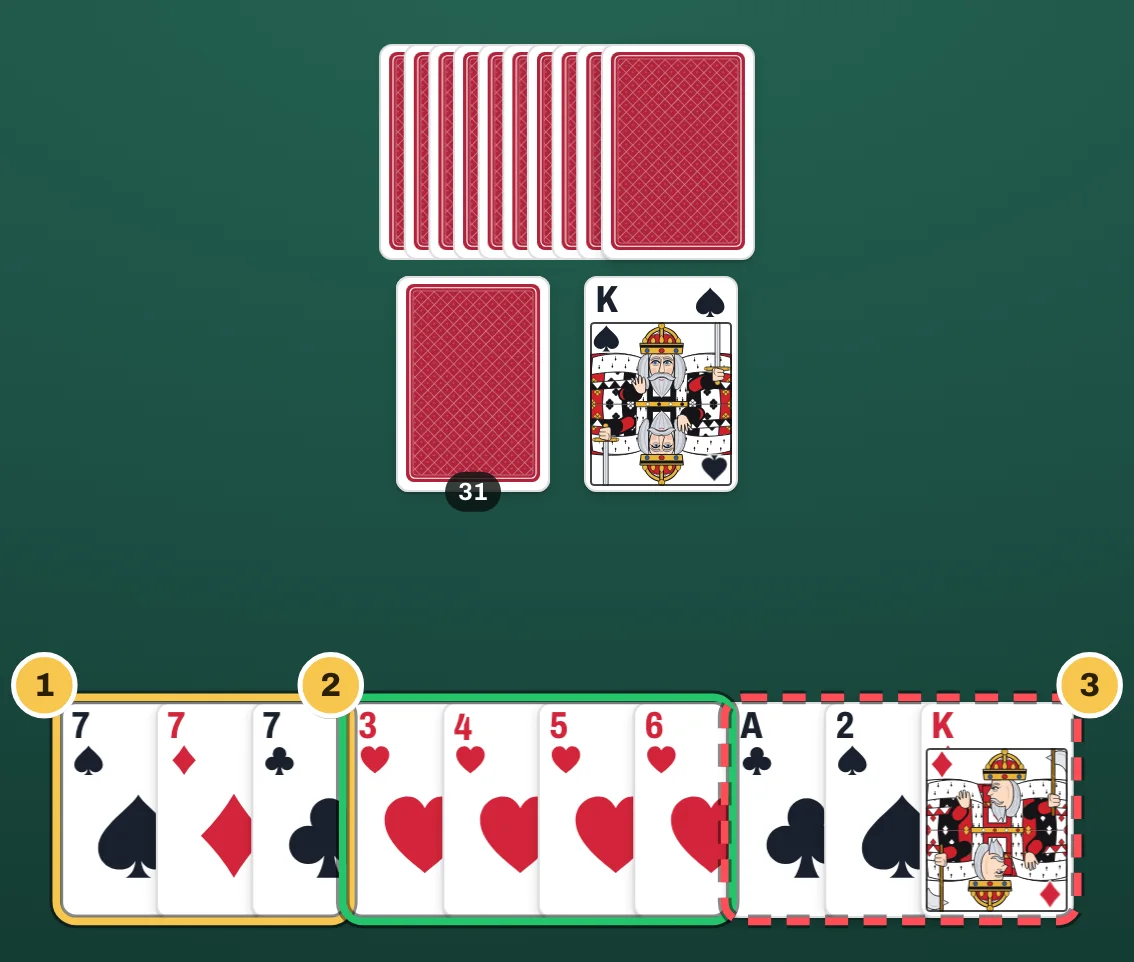
- A set is three or four cards of the same rank, such as three 7s.
- A run is three or more cards of the same suit in order, such as the 3, 4, 5 and 6 of hearts. The Ace is low: Ace, 2, 3 is a run, but Queen, King, Ace is not.
- A card belongs to one meld only. A 7 can't be in a set of 7s and in a run at the same time.
- Deadwood is every other card. Jacks, Queens and Kings count 10 points, Aces count 1, and the other cards count their number.
How to play, step by step
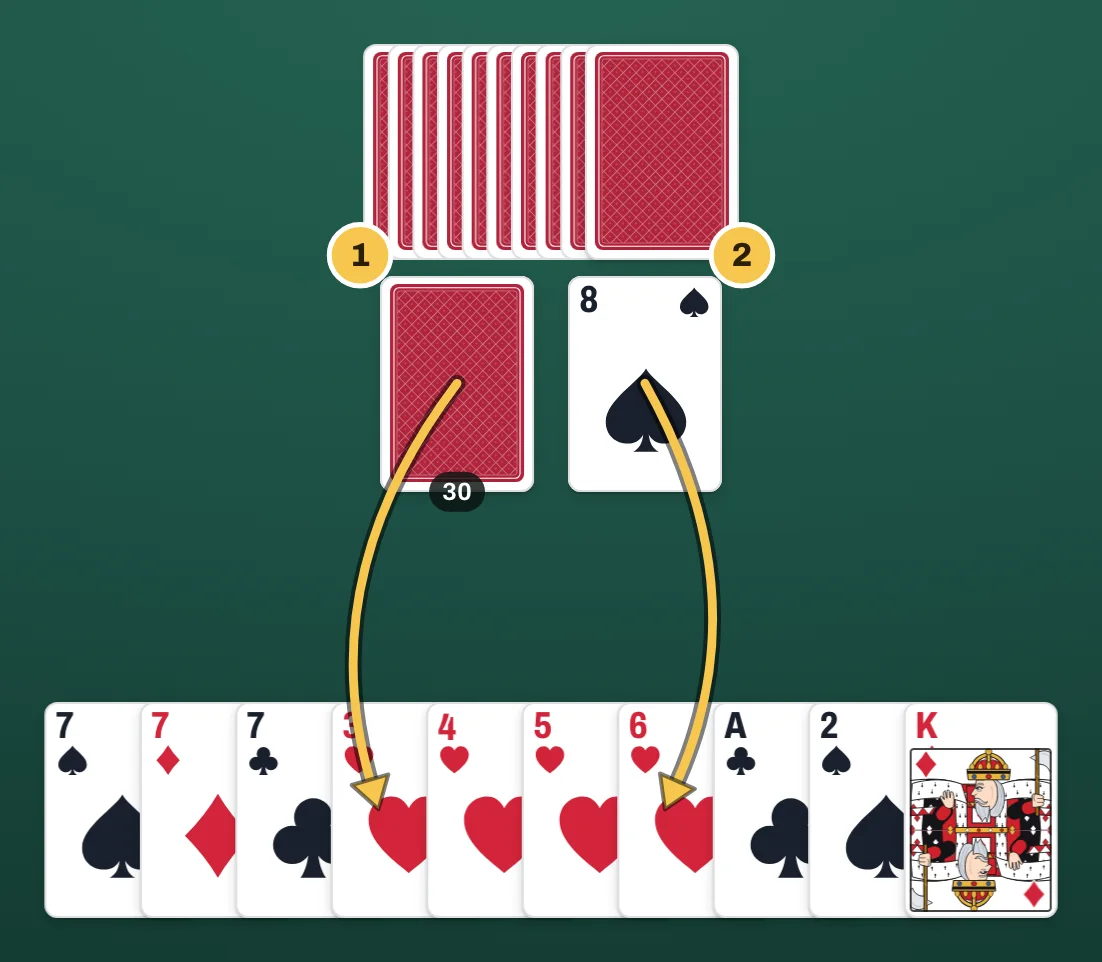
- Draw a card. Take the top card of the stock, or the top card of the discard pile.
- Discard a card. Tap a card in your hand to put it face up on the discard pile. You can't discard the card you just took from the discard pile.
- Knock when you can. If your deadwood counts 10 points or less after your discard, you may knock to end the hand. You don't have to: you can play on for a better hand.
- Go gin. If all ten of your cards are in sets and runs, you have gin.
- The hands are shown. After a knock, the other player may lay off deadwood cards that fit the knocker's sets and runs. After gin, nothing can be laid off.
Scoring
- Knock. If the knocker has less deadwood, they score the difference between the two counts.
- Gin. The player who goes gin scores the other player's deadwood plus 25 points.
- Undercut. If the other player ends with the same deadwood as the knocker or less, they score the difference plus 25 points instead.
- A drawn hand. If only two cards are left in the stock and nobody has knocked, the hand ends and nobody scores.
Common mistakes
Knocking as soon as you can is not always right. With 10 points of deadwood late in a hand you risk an undercut, because the other player has had time to build melds and can lay off cards on yours. Holding on to high cards for too long is the opposite mistake: a King and a Queen that never find a third card cost you 20 points when the other player knocks.
How you win
The first player to reach 100 points wins the game. The deal passes to the other player after each hand. For a shorter game, choose 50 points under New.
Controls
- Tap or click the stock or the discard pile to draw, and then a card in your hand to discard it.
- When a discard lets you knock, the game asks whether you want to knock or just discard.
- The line in the middle of the table shows how much deadwood your best discard leaves.
- Hint marks the pile a careful player would draw from, or the card they would discard.
- There is no Undo: a card you have drawn has been seen.
- On a keyboard, D draws from the stock, H shows a hint and N opens the new game options.
Tips for winning more games
- Get rid of high cards early. Unmatched Kings, Queens and Jacks are the most expensive deadwood. More on this: Gin Rummy tips: discard, knock and avoid the undercut.
- Keep cards that can grow two ways. The 6 and 7 of hearts become a run with either the 5 or the 8.
- Watch what the computer takes. If it takes the 9 of clubs, don't discard other 9s or clubs next to it.
- Remember the discards. A card buried in the discard pile will not come back, so a meld that needs it is dead.
- Knock early. In the first turns a knock usually catches the other player with a lot of deadwood.
Questions
What is the difference between knocking and gin?
You knock with some deadwood left, 10 points or less, and the other player may lay off cards on your melds. Gin means no deadwood at all: it earns a 25-point bonus, and the other player can't lay off anything.
What does laying off mean?
After a knock, the other player may add their deadwood cards to the knocker's melds: a fourth 7 to a set of three 7s, or the 8 of hearts to a run that ends with the 7 of hearts. Those cards no longer count against them. The game does this for both players.
How does the computer play?
It follows the same rules as you and sees only its own cards and the discard pile. It never looks at your hand or at the cards in the stock.
Is it free? Do I need an account?
Yes, it's free, and you don't need an account or a download. Your current game and your statistics are saved in this browser on this device. A free account is optional: it keeps your games on every device and puts your wins on the leaderboards.
What happens if I close the page?
Your game is saved after every turn you take. Open the page again in the same browser and you carry on where you were.
Can I play offline?
Yes. After your first visit, the game works without an internet connection. On a phone, add it to your home screen to open it like an app.