How to play Spider Solitaire
Spider is a solitaire game played with two decks. Your goal is to build eight runs from King down to Ace, each in a single suit. Every finished run leaves the table, and you win when all eight are gone.
The goal
Build eight runs, each from King down to Ace in a single suit. A finished run leaves the table by itself, and the game is won when all eight have gone.
Setting up
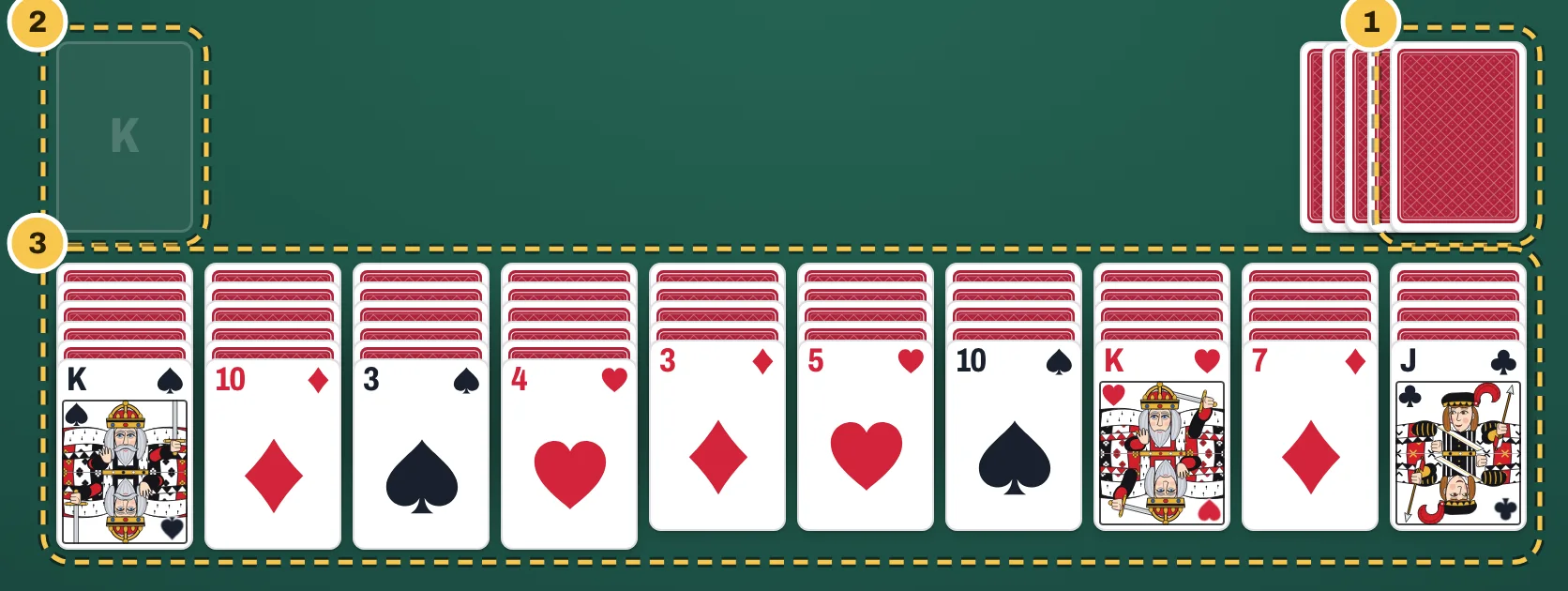
- Ten columns. The first four start with six cards and the other six with five, 54 cards in all. Only the top card of each column is face up.
- The stock holds the other 50 cards. Each deal puts one card face up on every column.
- Finished runs pile up at the top left, one King for each run (down the left side when the screen is short and wide).
How to play, step by step
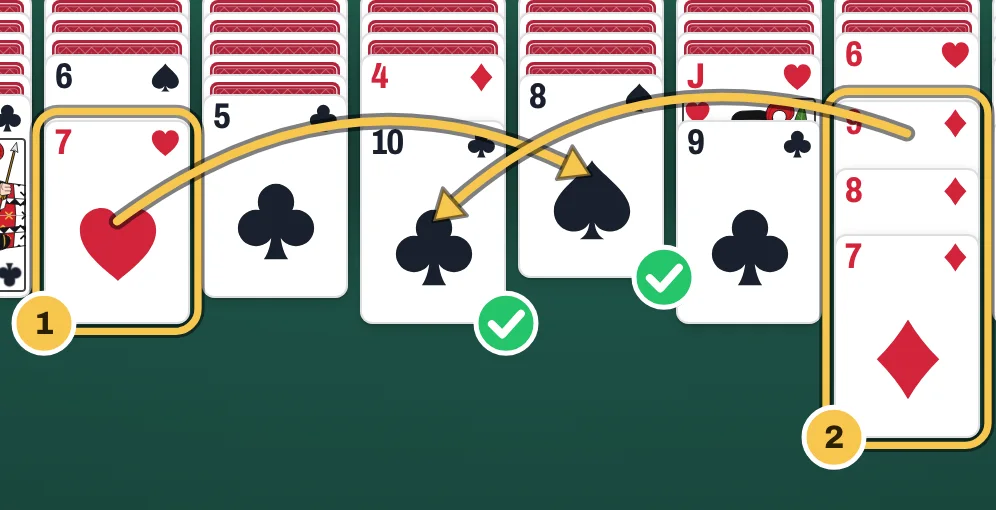
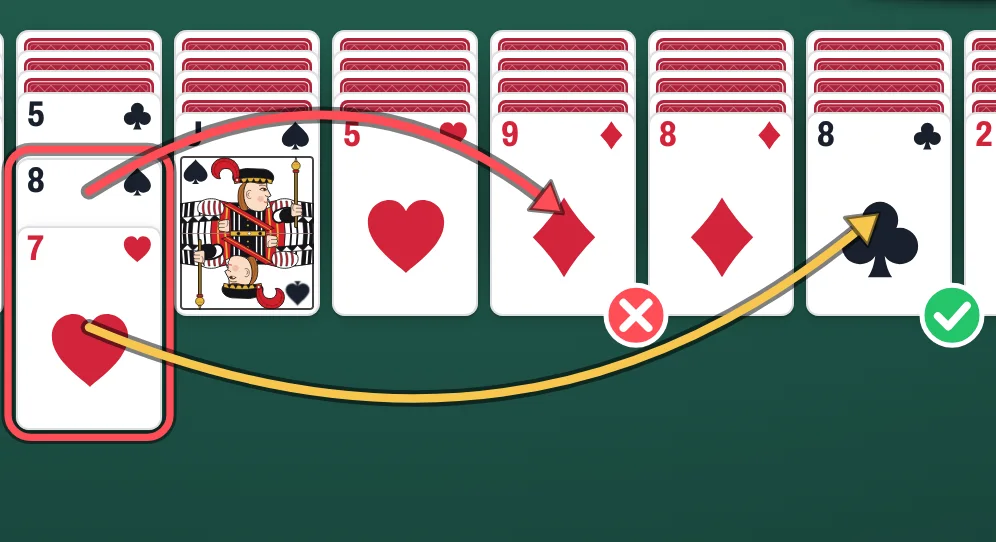
- Put a card on one rank higher, any suit. A 7 can go on any 8, a Jack on any Queen.
- Move groups only when they match. Cards move together only when they're in order and all one suit, like the 9, 8 and 7 of diamonds.
- Turn over hidden cards. When a face-down card is uncovered, it turns over.
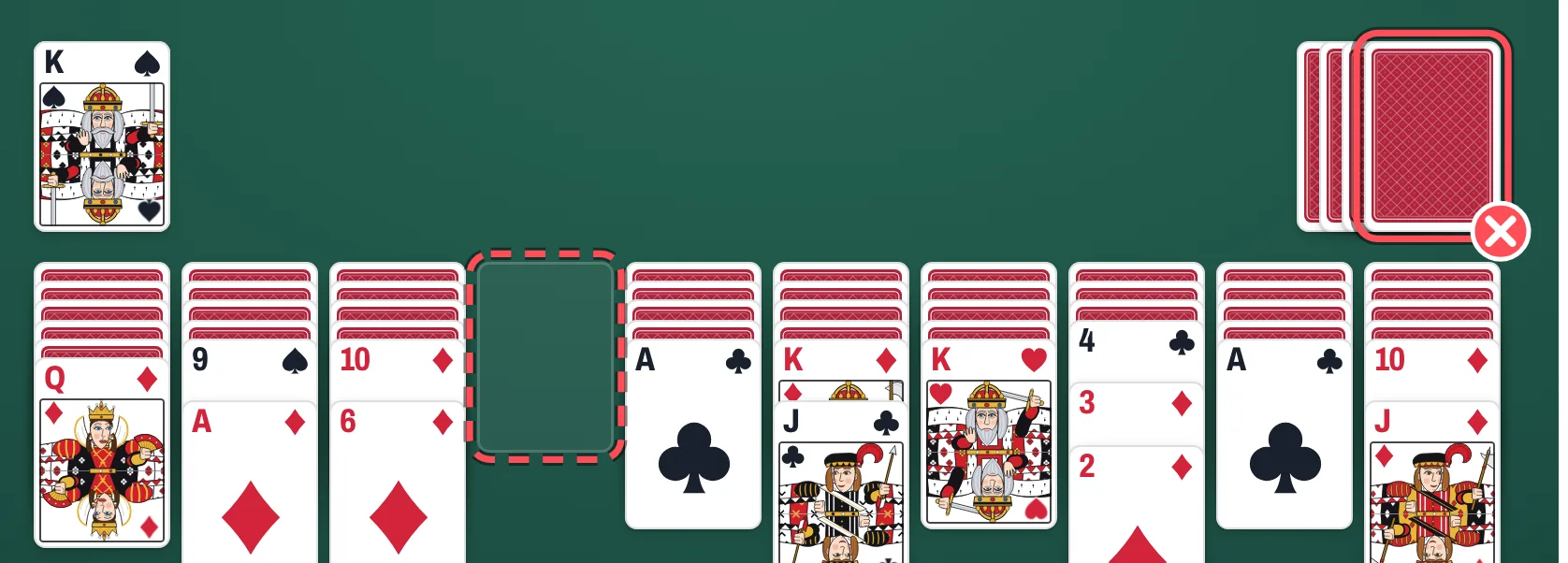
- Use empty columns. Any card, or any same-suit group, can go into an empty column.
- Finish a run. When a column holds King to Ace in one suit, the run leaves the table by itself.
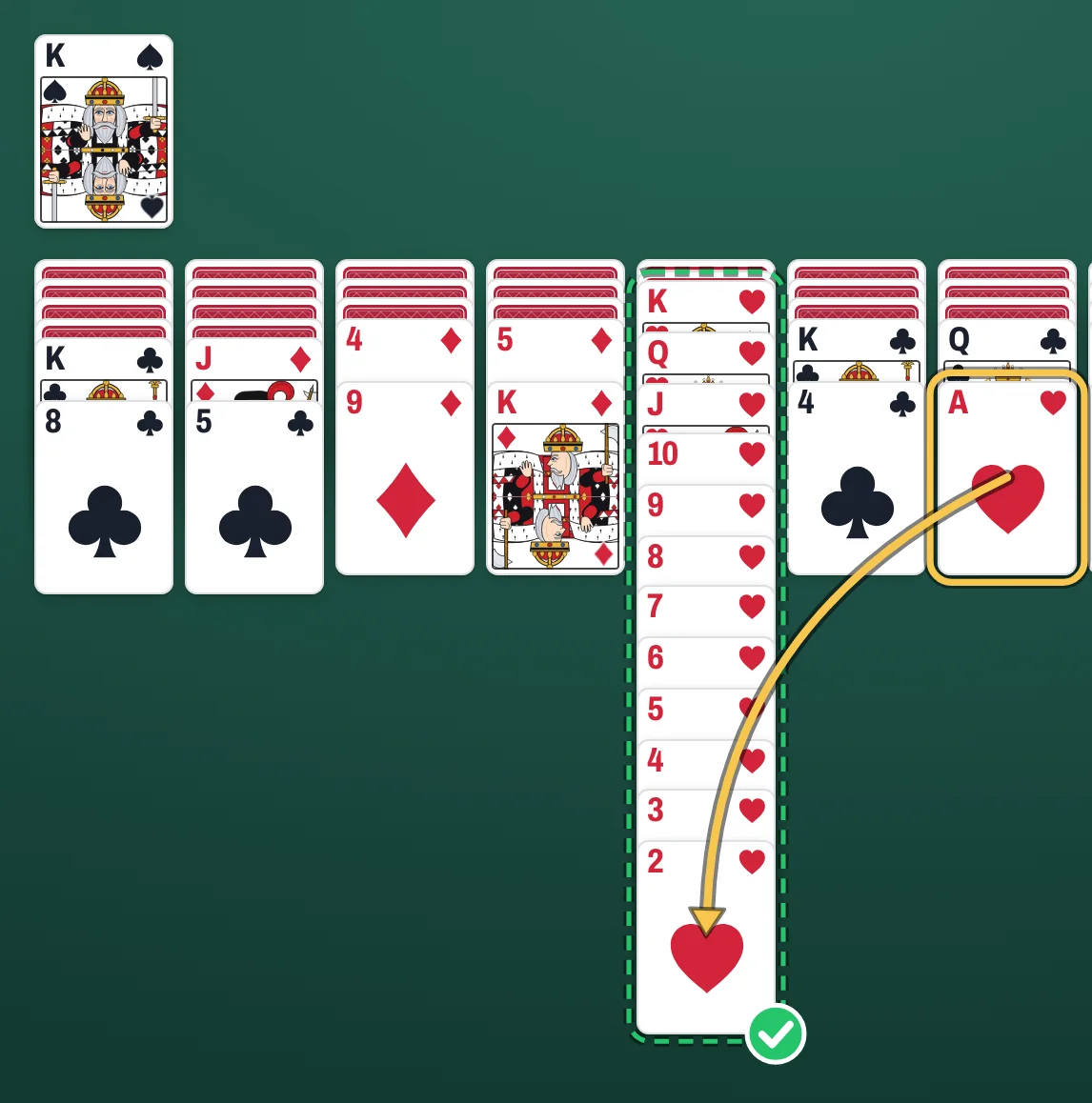
- Deal when you're stuck. Tap the stock to deal one card onto every column. Every column needs at least one card before you can deal.
Common mistakes
How you win
You win when all eight runs, King to Ace in one suit, have left the table. Every one of the 104 cards belongs to a run, so you'll deal the whole stock along the way. If no useful moves are left, the game tells you, and you can undo or start a new game.
1, 2 or 4 suits
With 1 suit, every card is a spade, so any run can move and every run can be finished. It's the best way to learn. 2 suits (spades and hearts) makes you think about which cards to stack. 4 suits is the classic, hardest game, where building in suit matters on every move. To switch, tap New and pick a mode. More on this: Spider Solitaire with 2 suits: how to choose your moves.
Controls
- Drag a card or a same-suit group onto another column. The places it can go light up while you drag.
- Tap or click a card to send it to the best place: onto a card of the same suit if it can, otherwise onto any card one higher, and into an empty column only when nothing else fits.
- Hint shows a useful move. Press it again to see another one.
- Undo takes back as many moves as you like, deals included.
- On a keyboard, Space or D deals, H shows a hint, Ctrl + Z or U undoes a move and N opens the new game options.
Scoring
| Event | Points |
|---|---|
| Starting score | 500 |
| Each move or deal | −1 |
| Each finished run | +100 |
Your score never goes below zero. Undo takes back a move, points included.
Tips for winning more games
- Turn over face-down cards. Every hidden card you uncover gives you more choices.
- Build in suit when you can. A same-suit run moves as a group. A mixed stack stays where it is.
- Empty a column whenever you can. An empty column is the best tool in the game. Use it to break up mixed stacks and rebuild them in suit.
- Make every useful move before you deal. A deal drops a card on every column and can bury what you were working on.
- Be careful with Kings. A King can't go on any card, only into an empty column, so a King lying on hidden cards can block that column for a long time.
- Start with 1 suit. Once you win regularly, move up to 2 suits, then 4.
- Use Undo to explore. Try a line of play, and if it goes nowhere, take it back.
Questions
Can every game be won?
No. Some deals can't be solved however you play, and wins are far more common with one suit than with four. In the classic four-suit game, even experienced players lose more games than they win.
How many cards does Spider use?
104, the same as two standard decks. With 1 or 2 suits, those suits repeat so there are still 104 cards.
Is it free? Do I need an account?
Yes, it's free, and you don't need an account or a download. Your current game and your statistics are saved in this browser on this device. A free account is optional: it keeps your games on every device and puts your wins on the leaderboards.
What happens if I close the page?
Your game is saved after every move. Open the page again in the same browser and you'll pick up where you left off.
Can I play offline?
Yes. After your first visit the game works without an internet connection. On a phone, add it to your home screen to open it like an app.
Why is it called Spider?
The usual explanation is the eight runs you need to finish, like a spider's eight legs, though nobody knows for sure. The game became widely known after Microsoft included it in Plus! 98 and then in Windows Me and Windows XP.
How is Spider different from Klondike?
Klondike uses one deck, builds in alternating colors and sends cards to the foundations one at a time. Spider uses two decks, lets you build on any suit, and only removes complete King-to-Ace runs.