Gin Rummy tips: discard, knock and avoid the undercut
Gin Rummy is a game of small decisions: which card to draw, which to throw away and when to end the hand. Get those right more often than your opponent and you win. These tips follow the rules used on our Gin Rummy page.
A quick reminder of the rules
- Each player has ten cards. On your turn you draw one, from the stock or the discard pile, then discard one.
- You try to form melds: sets of three or four cards of the same rank, and runs of three or more cards of the same suit in order. The Ace is low.
- Cards outside your melds are deadwood. Face cards count 10, Aces 1 and the others their number.
- When your deadwood counts 10 or less after a discard, you may knock to end the hand. With no deadwood at all, you have gin.
- After a knock, the other player may lay off deadwood on the knocker’s melds. The knocker scores the difference in deadwood. Gin earns the other player’s deadwood plus 25. If the other player ends with the same deadwood as the knocker or less, that’s an undercut: they score the difference plus 25.
- The first player to reach 100 points wins (or 50 in the short game).
Count your deadwood all the time
Every decision depends on one number: how many points of deadwood your hand holds. Count it after every draw, because it tells you how close you are to knocking and how much you would lose if your opponent knocked now. On Card Gamez, the line in the middle of the table shows how much deadwood your best discard leaves.
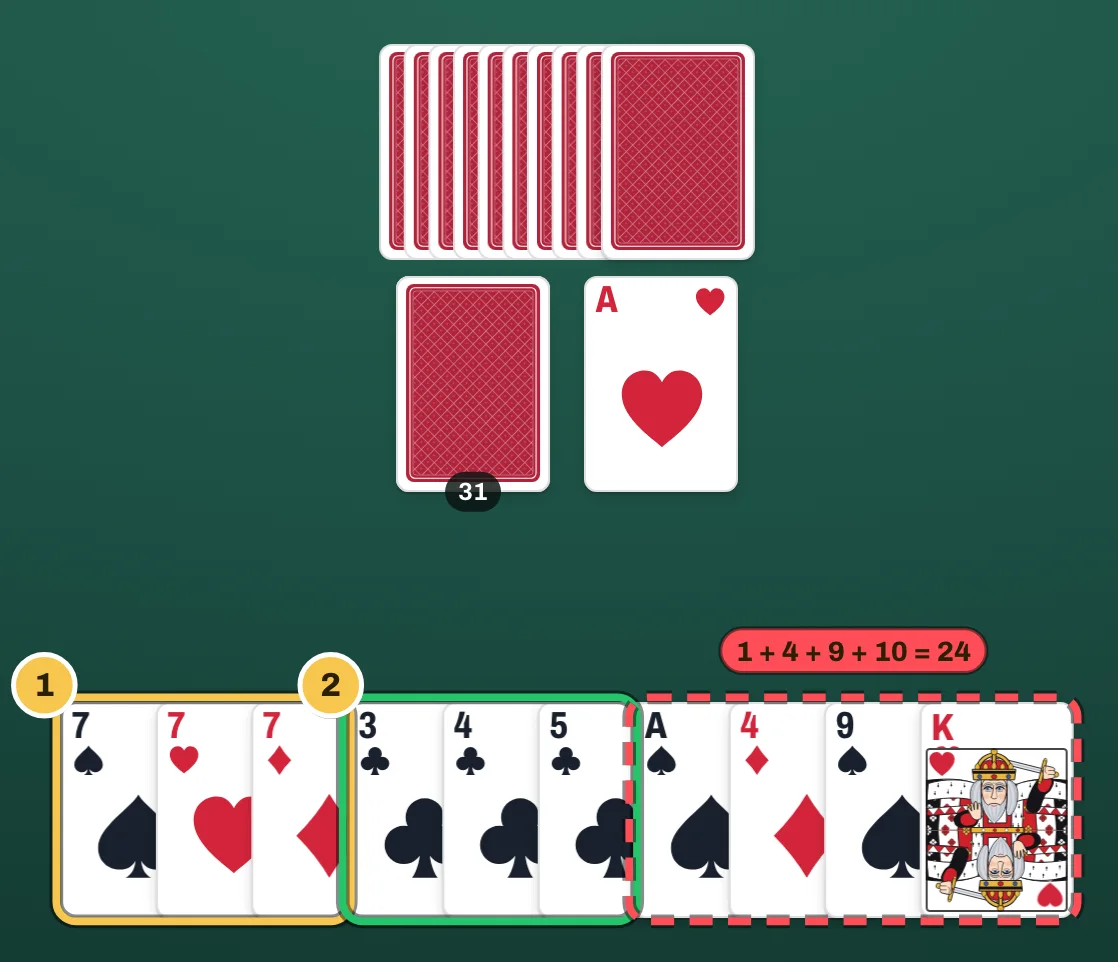
Example: you hold 7♠ 7♥ 7♦, 3♣ 4♣ 5♣, K♥, 9♠, 4♦, A♠. The set of 7s and the run of clubs are melds. Your deadwood is the K♥, 9♠, 4♦ and A♠: 10 + 9 + 4 + 1 = 24 points. The King is the first card to throw: without it, your deadwood would be 14.
Throw high cards early
A King or a Queen that never finds a partner costs you 10 points when your opponent knocks. In the first few turns, discard unmatched high cards before low ones: a 2 or a 3 left over costs you little, while two lonely face cards cost 20.
Keep cards that can grow in two directions
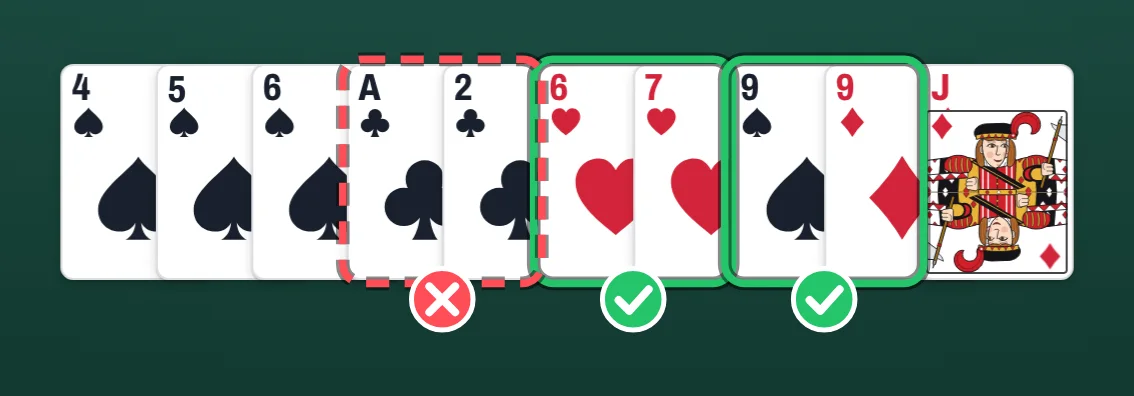
Not all half-made melds are equal. The 6♥ and 7♥ become a run with either the 5♥ or the 8♥, so two cards can complete it. A pair of 9s becomes a set with either of the two other 9s. But the 6♥ and 8♥ need exactly the 7♥, and the A♣ and 2♣ need exactly the 3♣, because nothing comes below the Ace. Prefer the combinations with more ways to finish.
Read the discard pile
Every card your opponent picks up or throws away tells you something.
- What they take shows what they’re building. If they take the 9♣, they probably hold other 9s or clubs near it, so don’t throw the 8♣, 10♣ or another 9 next.
- What they throw shows what they don’t need. Cards of the same rank, or next to it in the same suit, are usually safer discards for you.
- What is buried is gone for good. If both 8♥s you need for a set are in the discard pile, that meld can no longer be completed.
Take from the discard pile only with a reason
Picking up the top discard shows your opponent what you want. Take it when it completes a meld or clearly improves your hand. Otherwise, draw from the stock and keep your plans hidden. Remember too that you can’t discard the card you just took from the pile.
Knock early, think twice late
In the first turns of a hand, a knock usually catches your opponent with plenty of deadwood, so knock as soon as you can. Later in the hand it’s different: your opponent has had time to build melds and may hold cards that lay off on yours. Knocking with 9 or 10 points late in a hand is a common way to be undercut.
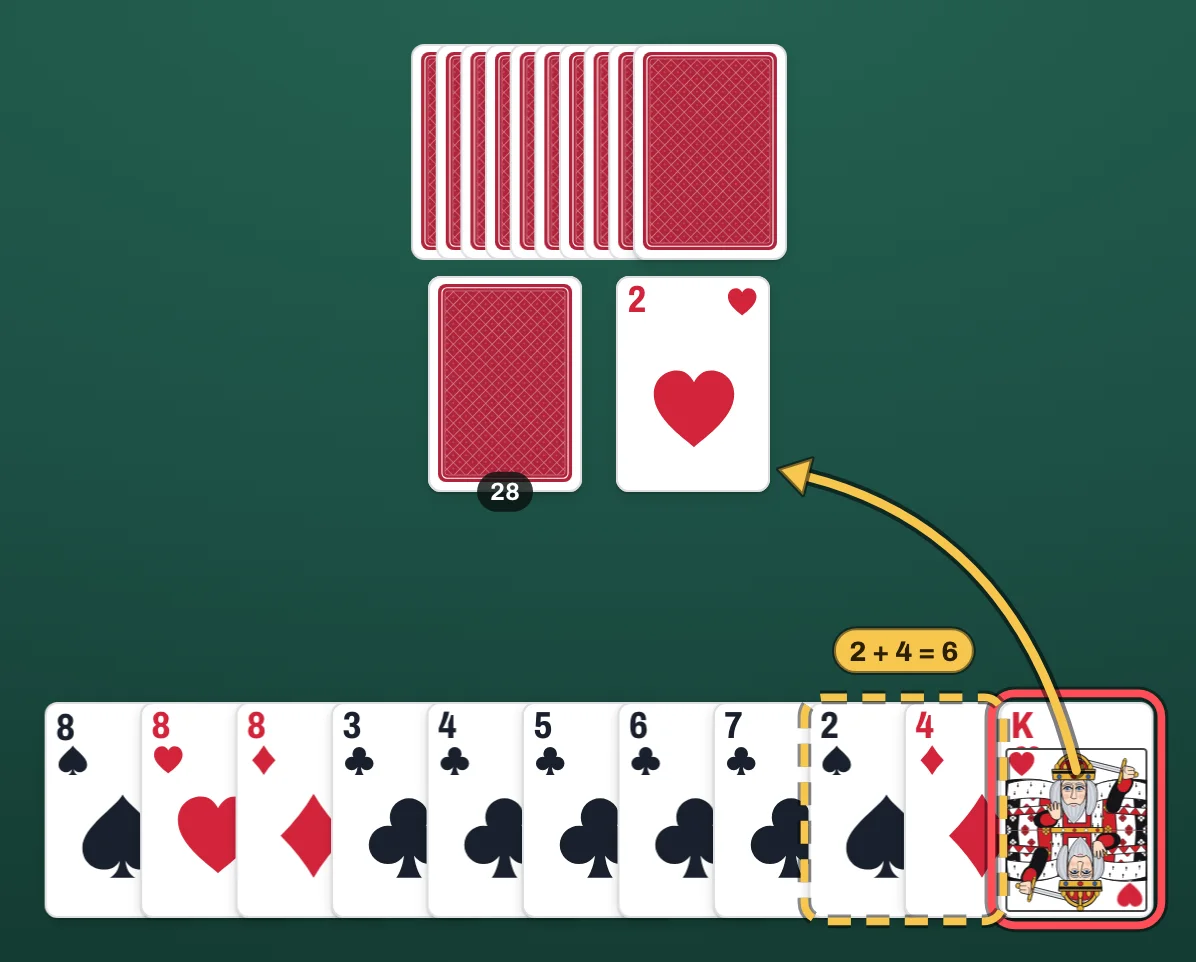
Knock: you knock with 6 points and your opponent ends with 21 after laying off. You score 21 − 6 = 15.
Undercut: you knock with 8 points, but your opponent lays off down to 7. They score 8 − 7 + 25 = 26.
Late in a hand, if your deadwood is close to 10 and your opponent has been picking up discards, it can be better to keep playing and aim for a lower count, or for gin.
When to go for gin
Gin earns 25 extra points and can’t be undercut, because nothing can be laid off on a gin hand. If you are one card from gin and the stock is still deep, it can pay to wait instead of knocking. If the stock is running low, take the sure points: when only two cards are left in the stock and nobody has knocked, the hand is a draw and nobody scores.
Common mistakes
- Holding on to pairs of face cards for too long.
- Discarding a card next to one your opponent has just picked up.
- Knocking automatically, without counting the risk of an undercut.
- Taking discards that don’t make a meld, and so showing your hand.
- Forgetting which cards are already buried in the discard pile.
Practise with hints
On Card Gamez you play against a computer opponent that follows the same rules and sees only its own cards and the discard pile. Press Hint to see which pile a careful player would draw from, or which card they would discard, and compare it with your own idea. For quick practice, choose a game to 50 points under New.