How to play Pyramid Solitaire
Pyramid is a quick solitaire game about adding up to 13. Your goal is to clear all 28 cards from the pyramid by removing pairs of cards whose values add up to 13.
The goal
Clear all 28 cards from the pyramid by removing pairs that add up to 13. Kings count 13 on their own, so they leave alone. Cards left in the stock and the waste at the end don't count against you.
Setting up
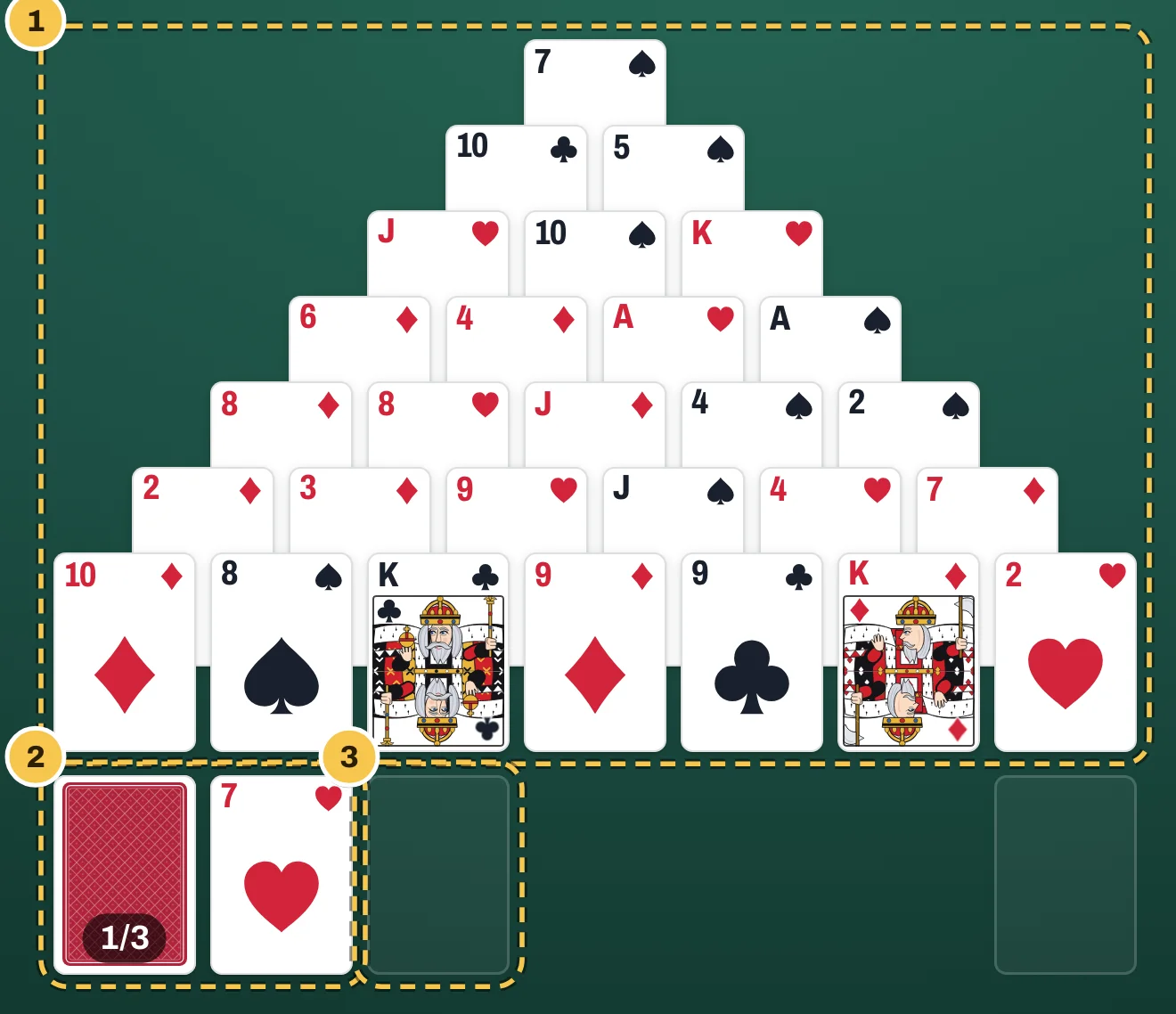
- The pyramid: 28 cards dealt face up in seven rows. Each card is partly covered by the two cards below it.
- The stock: the other 24 cards. Its top card is face up and ready to play.
- The waste: where cards from the stock go. Its top card can be played too.
Pairs that make 13
An Ace counts 1, number cards count their number, a Jack counts 11, a Queen 12 and a King 13.
| Card | Pairs with |
|---|---|
| Ace | Queen |
| 2 | Jack |
| 3 | 10 |
| 4 | 9 |
| 5 | 8 |
| 6 | 7 |
| King | Nothing: it goes on its own |
How to play, step by step
- Find a free card. A pyramid card can be played once both cards covering it are gone. The bottom row is free from the start.
- Remove pairs that make 13. Pick two free cards that add up to 13 and they leave the table. Kings are removed on their own.
- Pair from anywhere. A pair can be two pyramid cards, a pyramid card and the stock or waste card, or the stock card and the waste card.
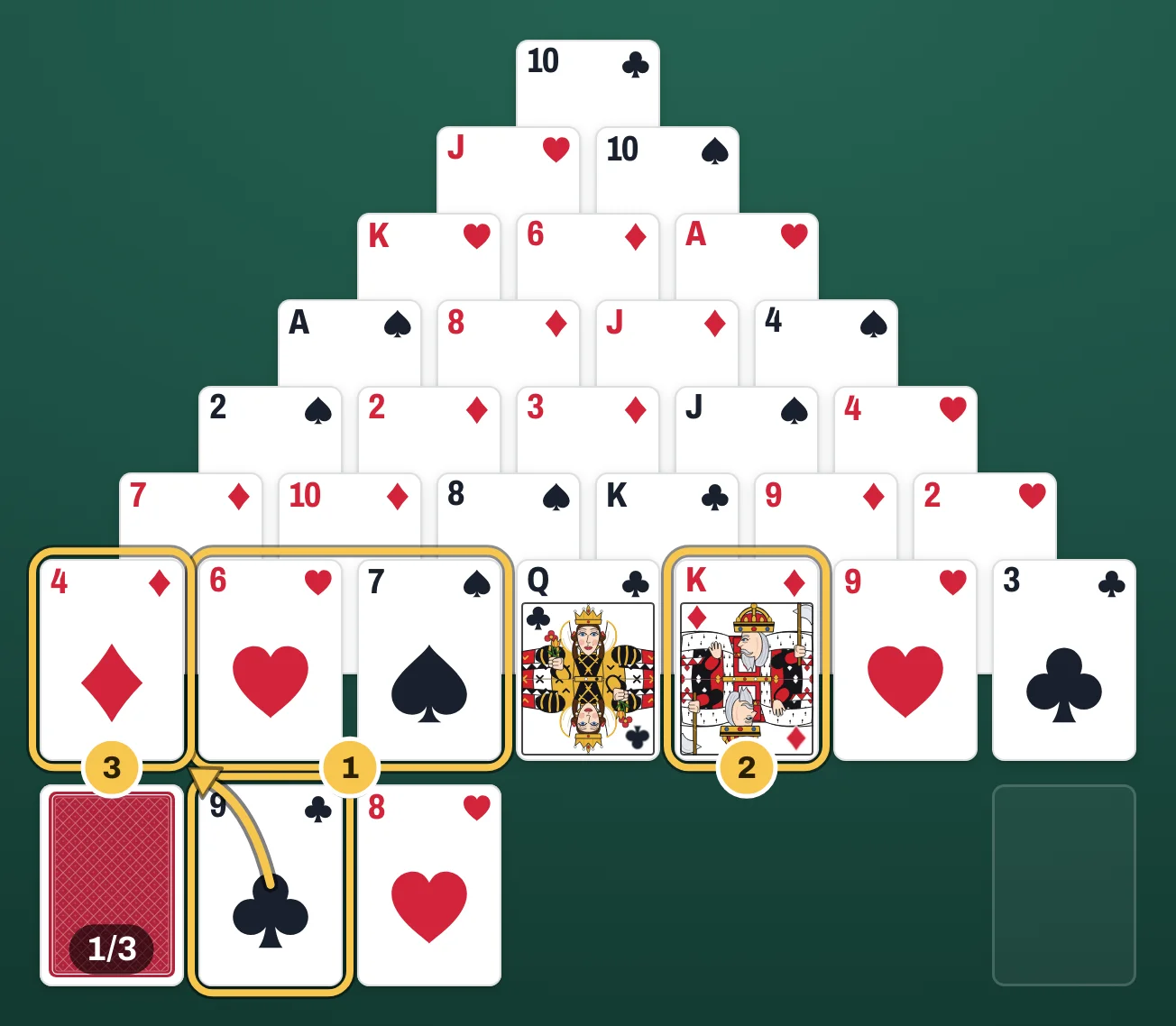
- Turn the stock. Tap the face-down stock to move its top card onto the waste and turn up the next one.
- Go round again if your game allows it: when the stock runs out, tap it to turn the waste over and start another pass.
Common mistakes
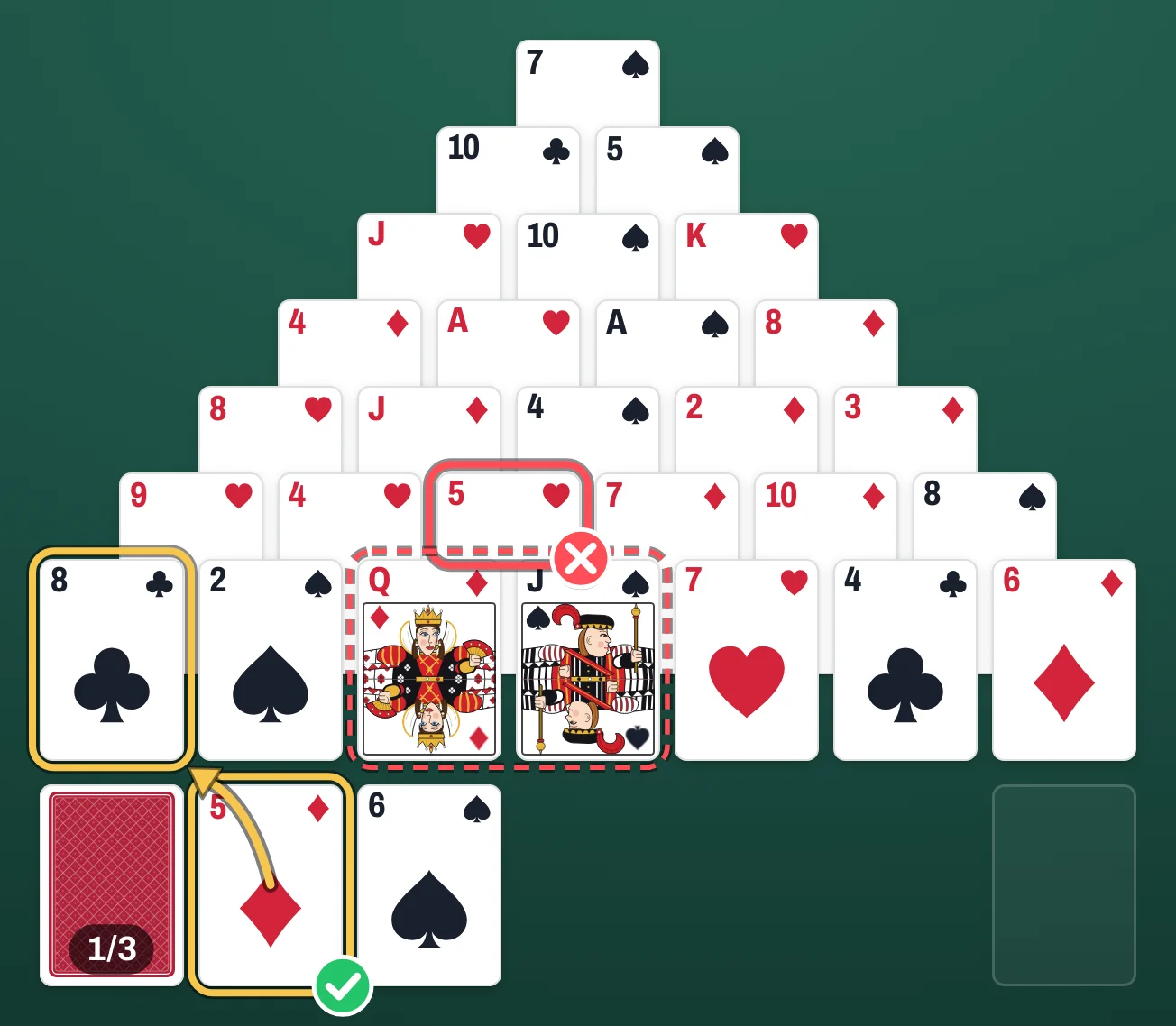
Also check the sum: a pair has to make exactly 13. An 8 and a 6 make 14, so they stay. And a card covered by just one card below it is still blocked: both cards covering it have to go first.
How you win
You win as soon as the last pyramid card is gone, even with cards left in the stock and the waste. When there are no pairs left and no passes to make, the game tells you, and you can undo or deal again.
1 pass, 3 passes or unlimited
With 3 passes, the rule in Microsoft's version, you can turn the waste over twice. 1 pass gives you one trip through the stock, so every pair counts. With Unlimited you can go round as often as you like. To switch, tap New and pick a mode.
Controls
- Tap or click a card to pick it. The cards it pairs with light up: tap one of them to remove both.
- Drag a card onto a card it pairs with, if you prefer.
- Tap a King to remove it.
- Tap the stock to deal the next card. Tapping the face-up stock card when it can't pair moves it along too.
- Hint shows a useful pair, or tells you to deal. Press it again to see another one.
- Undo takes back as many moves as you like.
- On a keyboard, Space or D deals from the stock, H shows a hint, Ctrl + Z or U undoes a move, Esc lets go of a picked card and N opens the new game options.
Scoring
| Move | Points |
|---|---|
| Removing a pyramid card | +10 |
| Removing a stock or waste card | +5 |
| Clearing the pyramid | +250 |
| Turning the waste over | −50 |
Your score never goes below zero. Undo takes back a move, points included.
Tips for winning more games
- Look before you pair. All 28 pyramid cards are face up, so you can see which cards are blocking the ones you need.
- Open up the middle. A card in the middle of a row covers two cards above it. Removing it frees more of the pyramid than a card at the edge.
- Count what's gone. There are four of each card. If three Queens are already out, the Aces still in play all need the last one.
- Save stock cards for the pyramid. Pairing the stock card with the waste card is easy points, but the pyramid might need one of them later.
- Watch the face-up stock card. You can see the next card before you deal it. Use that to decide what to pair now.
- Kings are free. Remove them whenever they're uncovered: they never pair with anything.
- Use Undo to explore. Try a line of play, and if it goes nowhere, take it back. It costs nothing.
Questions
Can every game be won?
No. In a test of 1,500 random deals under Microsoft's rules, a solver that could see every card cleared about two out of three. With only one pass through the stock, computer players clear far fewer, under one deal in ten. You can't see the whole stock in advance, so expect to win less often than a computer that can.
Why do pairs add up to 13?
Because a King counts 13. Jacks count 11 and Queens 12, so every pair adds up to the value of a King, and a King can go on its own.
Where does Pyramid come from?
Nobody knows who invented it. Microsoft released a version called Tut's Tomb in Microsoft Entertainment Pack 2 in 1991, and Pyramid is one of the games in Microsoft Solitaire Collection, which comes with Windows 10. This game's 3-pass mode follows that version's rules: the top card of the stock is face up and playable, and you can go through the stock three times.
Is it free? Do I need an account?
Yes, it's free, and you don't need an account or a download. Your current game and your statistics are saved in this browser on this device. A free account is optional: it keeps your games on every device and puts your wins on the leaderboards.
What happens if I close the page?
Your game is saved after every move. Open the page again in the same browser and you'll pick up where you left off.
Can I play offline?
Yes. After your first visit the game works without an internet connection. On a phone, add it to your home screen to open it like an app.