How to play Nonograms
A nonogram is a picture hidden in a grid. The numbers beside each row and above each column tell you which of its cells are filled, and logic alone leads you to the picture. Every puzzle here can be solved without guessing.
The goal
Fill exactly the cells of the hidden picture, so that every row and every column matches its numbers.
Setting up
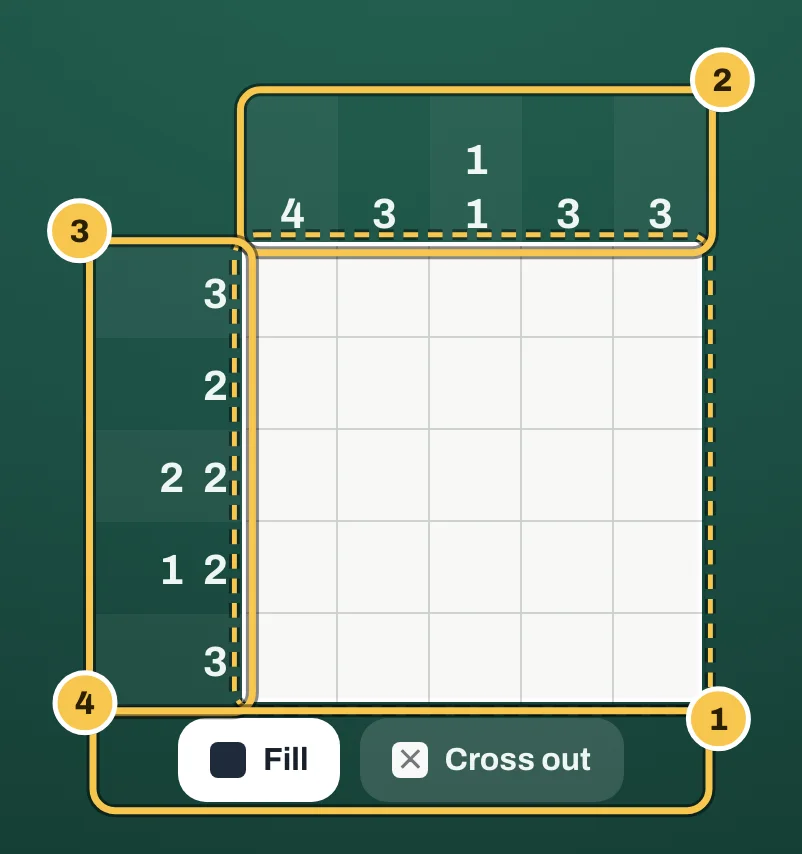
- The grid. 5 by 5 cells on Easy, 10 by 10 on Medium, 15 by 15 on Hard. Heavier lines mark every fifth cell.
- The numbers. Above each column and to the left of each row: the lengths of the runs of filled cells in that line, in order.
- Between runs. At least one empty cell. “3 1” means a run of three cells, then at least one empty cell, then one filled cell.
How to play, step by step
- Start with the big numbers. A long run in a short line can only lie in a few places, and some of its cells are filled in all of them.
- Find the overlap. Push a run as far left as it can go, then as far right: the cells it covers both times are filled.
- Cross out. When all the runs of a line are in place, cross out its other cells: they are sure to be empty.
- Switch between rows and columns. Every cell you fill or cross out tells you something about the line running the other way.
- Watch the numbers. A line's numbers grey out once its filled cells match them.
- Finish. The puzzle is solved when every cell of the picture is filled. Crosses are only notes for you.
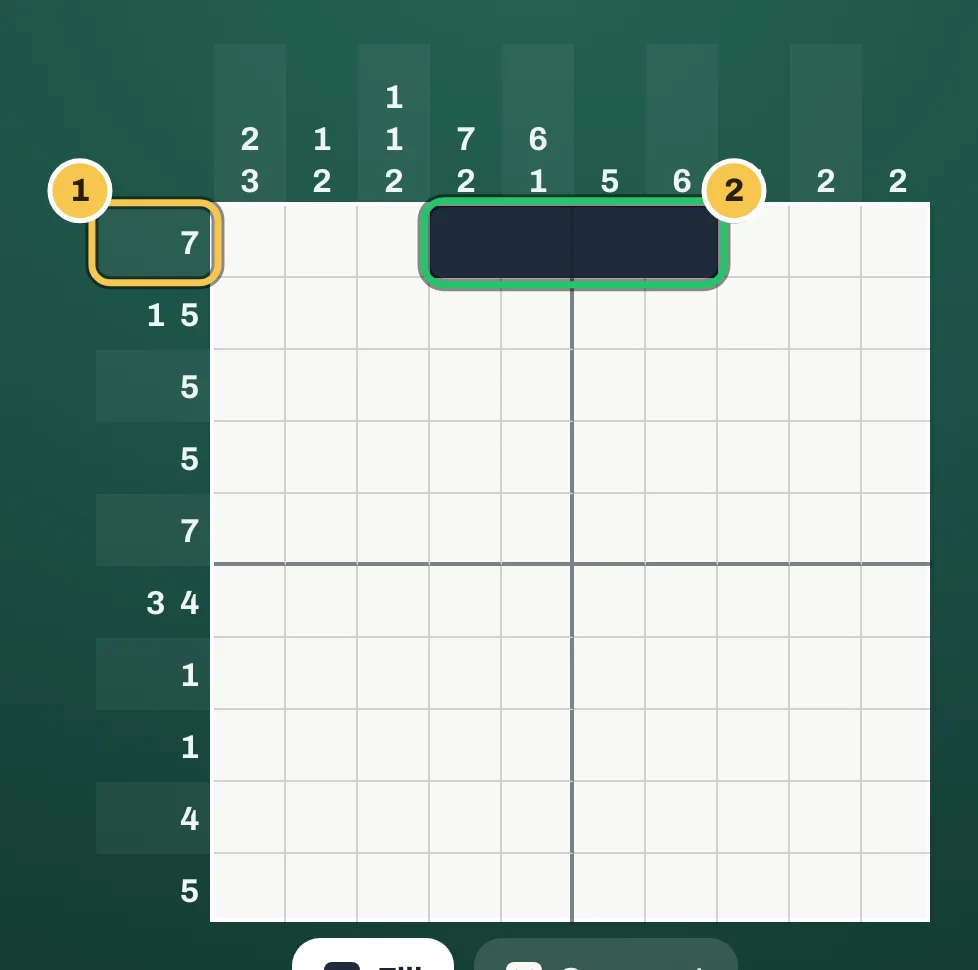
Common mistakes
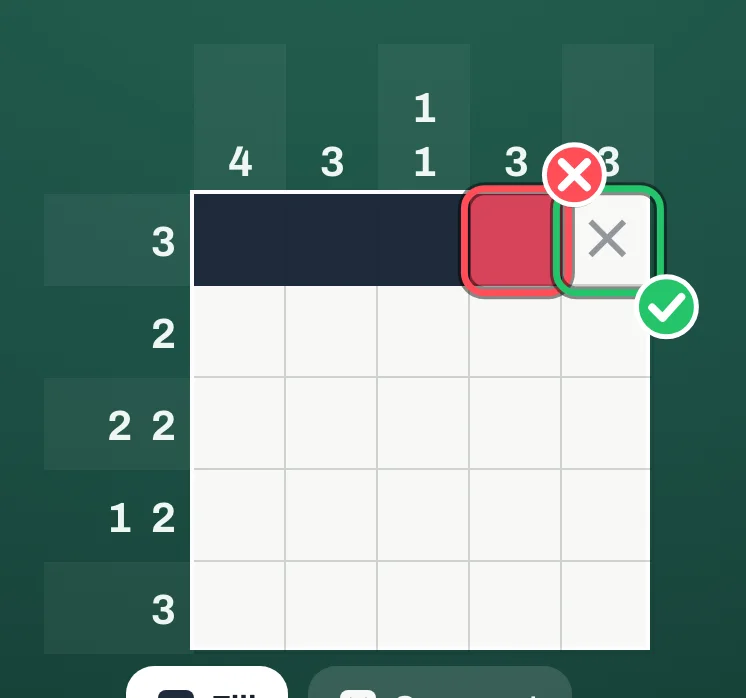
Two more things catch new players. The order of the numbers matters: “1 3” is a single cell and then a run of three, never the other way round. And a number only says how long a run is, not where it starts: work it out from the edges and the cells you already know.
Levels and mistakes
| Level | Grid |
|---|---|
| Easy | 5 by 5 cells |
| Medium | 10 by 10 cells |
| Hard | 15 by 15 cells |
Nonograms have no points. The top bar shows how many cells of the picture are still to fill and how many mistakes you made: cells filled that turned out not to be part of the picture.
How you win
Fill every cell of the picture. Your time and mistakes are kept in the statistics for each level. Choose the level under New.
Undo and hints
Undo takes back your last mark. Hint first points out a cell filled by mistake; otherwise it shows a cell whose row or column numbers already decide it, and which line that is.
Controls
- Tap a cell to fill it, or to cross it out when Cross out is chosen. Tap it again to clear it.
- Drag across several cells to mark them all the same way.
- On a keyboard, the arrow keys move the cursor, Space fills, X crosses out and F switches the tool.
- U takes back a mark, H shows a hint and N opens the new puzzle options.
Tips for solving faster
- Add the numbers. The runs of a line plus one gap between each: if that equals the line's length, the line is decided.
- Use the edges. A filled cell next to the edge starts the first run there: fill the rest of it and cross out the cell after it.
- Cross out freely. Crosses cost nothing and make the next steps easier to see.
- Look for zeros. A line marked 0 is empty: cross it all out.
- Work in fives. The heavier lines help you count cells without mistakes.
- Check finished lines. When a line's numbers grey out, cross out what is left in it.
Questions
Does every puzzle have one solution?
Yes. Each picture is checked before you see it: it can be solved one row or column at a time, by logic alone, which also means it has exactly one solution.
Do crosses matter for winning?
No. They are notes for you. The puzzle is solved as soon as every cell of the picture is filled.
What makes a level harder?
The size of the grid. Bigger pictures have more numbers to combine, and more steps that depend on each other.
Is it free? Do I need an account?
Yes, it's free, and you don't need an account or a download. Your current game and your statistics are saved in this browser on this device. A free account is optional: it keeps your games on every device and puts your wins on the leaderboards.
What happens if I close the page?
Your puzzle is saved after every mark. Open the page again in the same browser and you carry on where you were.
Can I play offline?
Yes. After your first visit, the game works without an internet connection. On a phone, add it to your home screen to open it like an app.