How to play Canfield Solitaire
Canfield is a classic one-deck solitaire, named after a famous American casino owner and known in Britain as Demon. Your goal is to move all 52 cards to the four foundations, and the key is getting the cards out of the reserve.
The goal
Move all 52 cards to the four foundations, one per suit. The catch: the foundations don't start at the Ace but at whatever rank is dealt to them first, and 13 cards wait in the reserve.
Setting up
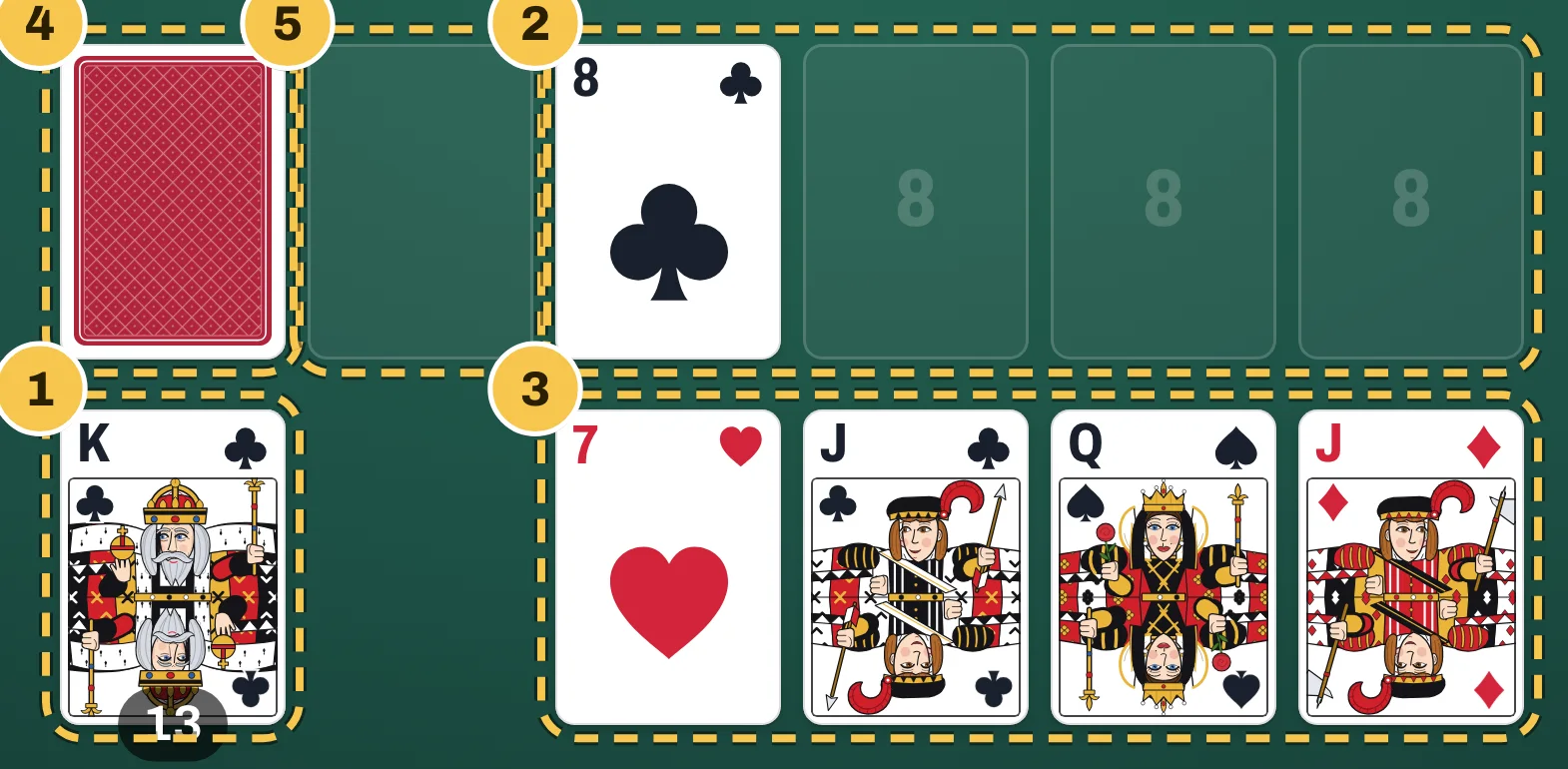
- The reserve: 13 cards, with only the top one face up. The number under it shows how many are left.
- Four foundations. The first card dealt to them sets the starting rank for all four.
- Four piles, one card each to start.
- The stock holds the other 34 cards. You turn them over onto the waste.
How to play, step by step
- Start foundations with the base rank. Only a card of the starting rank can begin an empty foundation. Then build up in suit, going on from King to Ace: if the first card is a 7, each foundation runs 7, 8 … Queen, King, Ace, 2 … 6.
- Build the piles down in alternating colors, red on black or black on red. They also go round the corner: a King can go on an Ace.
- Move cards between piles. You can move the top card of a pile, or a run of cards in sequence, onto another pile. (Some old rule books only let a whole pile move.)
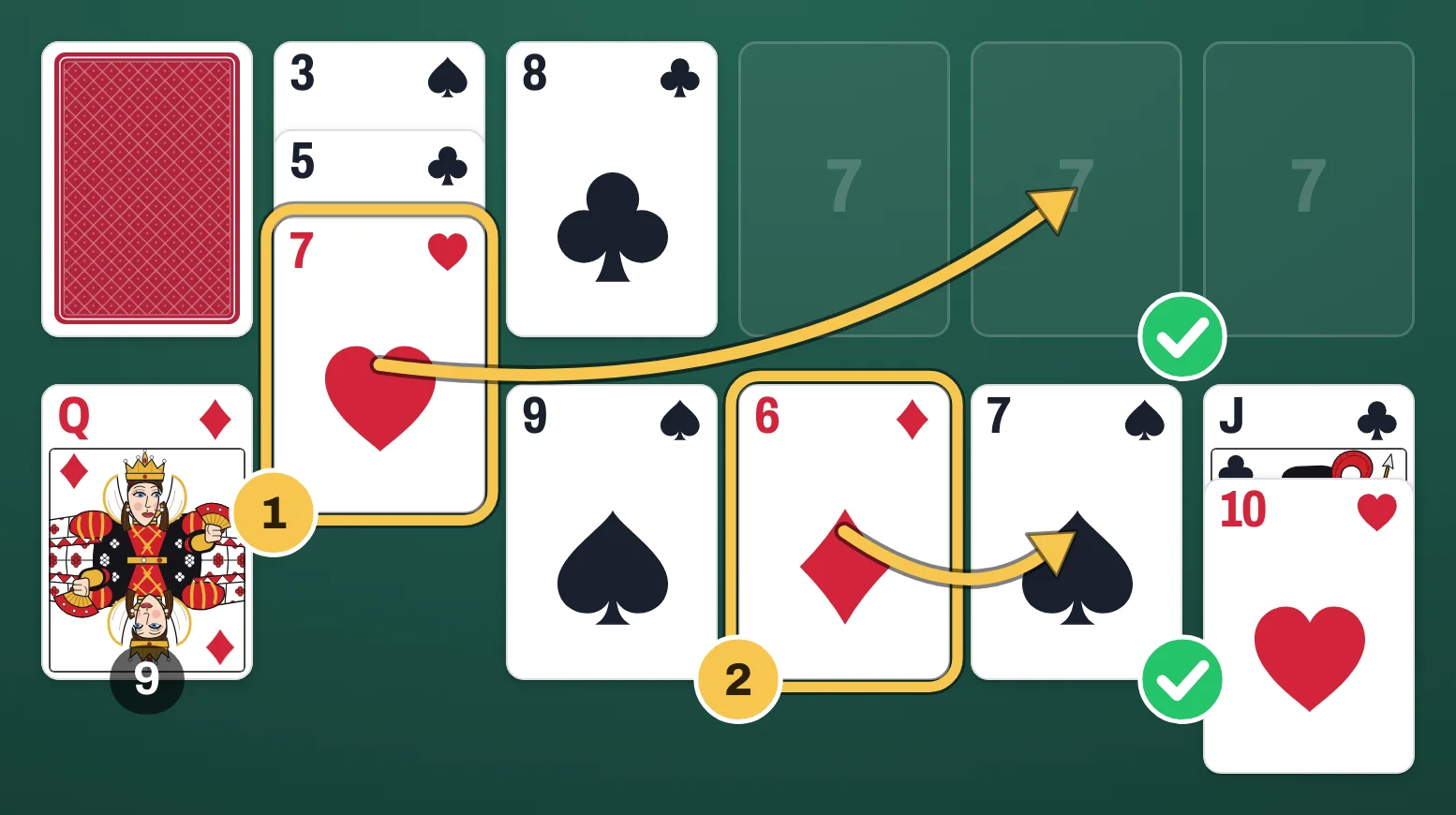
- Empty piles fill from the reserve. An empty pile takes the top card of the reserve at once. Once the reserve is used up, any card can fill an empty pile.
- Turn the stock. Tap it to turn over three cards (one in Draw 1). Only the top card of the waste can be played. When the stock runs out, tap it to turn the waste back over, as often as you like.
Common mistakes
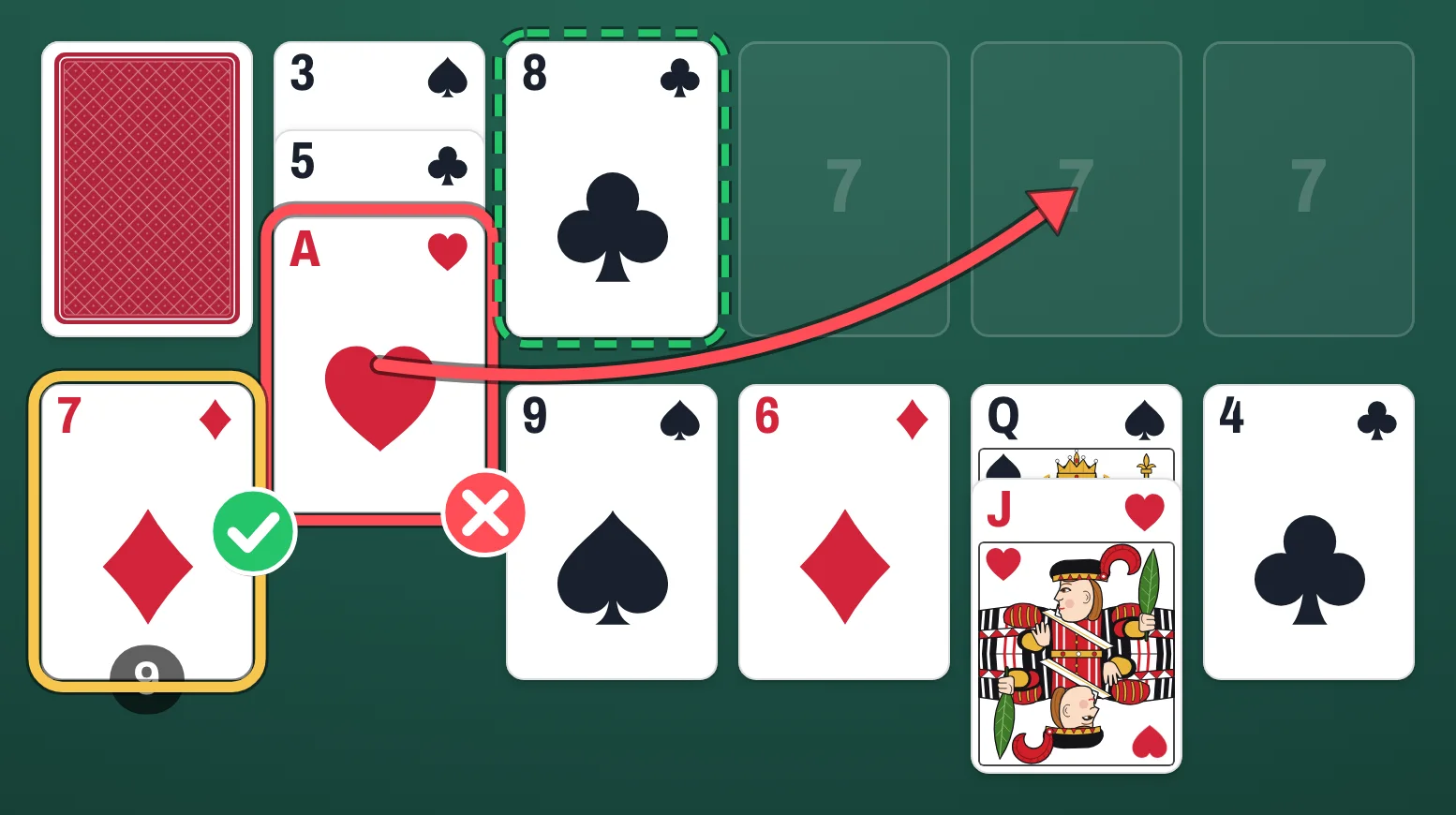
Two more things people expect but the rules don't allow: playing a waste card from under the top one, and taking a card back off a foundation. Cards on the foundations stay there.
How you win
You win when all 52 cards are on the foundations. In practice the reserve decides the game: every card in it has to come out, one at a time from the top. When you're out of moves, the game tells you.
Draw 3 or Draw 1
Draw 3 is Canfield as it has always been played, and it's hard. Draw 1 turns over one card at a time, which makes the game a good deal easier. To switch, tap New and pick a mode.
Scoring
| Move | Points |
|---|---|
| Buying the deck, at the start of a game | −52 |
| Each card on a foundation, the first one included | +5 |
The score follows Canfield's casino. A new game starts at −47, you're ahead once 11 cards are up, and a won game scores 208. Here it's only points, and your best score in Statistics counts the games you didn't win, too.
Controls
- Drag a card or a run onto a pile or a foundation. The places it can go light up while you drag.
- Tap or click a card to send it to the best place: a foundation if it fits there, otherwise a pile (or, once the reserve is used up, a space).
- Tap the stock to turn over the next cards.
- Hint shows a useful move. It plays the reserve first and looks a few moves ahead.
- Undo takes back as many moves as you like.
- When the reserve is used up and the rest is a matter of time, the Finish button plays it out for you.
- On a keyboard, Space or D turns over the stock, H shows a hint, Ctrl + Z or U undoes a move and N opens the new game options.
Tips for winning more games
- Play the reserve first. Every reserve card you get out is progress, and most lost games end with cards stuck there.
- Make empty piles. The reserve fills a space at once, so moving a whole pile onto another one is the quickest way to bring a reserve card into play.
- Look at the reserve before you send a card up. If the top reserve card could go on it, that card may be worth more in its pile.
- Watch the order of the stock. With Draw 3, playing one waste card changes which cards come up next time through.
- Once the reserve is gone, keep a space free. An empty pile takes any card, which makes it the most useful spot on the table.
- Use Undo to explore. Try a line of play, and if it goes nowhere, take it back. It costs nothing.
Questions
Can every game be won?
No. A computer that can see every card can win about 71% of deals, but in a real game the reserve and the stock are hidden, and it's very hard to get anywhere near that. Draw 1 is much easier.
Why is it called Canfield?
It's named after Richard A. Canfield, who in 1894 took over a famous gambling house in Saratoga Springs, New York. Some time after 1900 he is said to have offered the game to his customers: you bought a deck for $50 or $52 and won $5 for every card you got to the foundations. Canfield himself called his game Klondike, and it may in fact have been Klondike rather than this one. Either way, it never really caught on.
Is Canfield the same game as Demon?
Yes. It was first written down in England in 1891, by Mary Whitmore Jones, as Demon Patience, and in Britain it's still called Demon. To add to the confusion, British books often use the name Canfield for the game Americans call Klondike.
Is it free? Do I need an account?
Yes, it's free, and you don't need an account or a download. Your current game and your statistics are saved in this browser on this device. A free account is optional: it keeps your games on every device and puts your wins on the leaderboards.
What happens if I close the page?
Your game is saved after every move. Open the page again in the same browser and you'll pick up where you left off.
Can I play offline?
Yes. After your first visit the game works without an internet connection. On a phone, add it to your home screen to open it like an app.