Klondike strategy: 9 practical ways to win more games
Once you know the rules of Klondike, winning more often comes down to choosing well between the moves on offer. These nine strategies are the ones that make the biggest difference, in Turn 1 and in Turn 3. If you’re just starting out, read 10 Solitaire mistakes beginners make first.
1. Use a fixed order for choosing moves
When several moves are possible, go through them in this order and take the first that applies:
- Send up any Ace or 2.
- Make a move that turns over a face-down card, starting with the column that hides the most.
- Make a move that empties a column, but only if a King is ready to fill it.
- Play a card from the waste to a column, if it helps you build or frees a card.
- Turn over the stock.
The order matters because the moves at the top can only help you, while the ones lower down use up resources: an empty column, a stock card, a place to build.
2. Know when a card is safe to send home
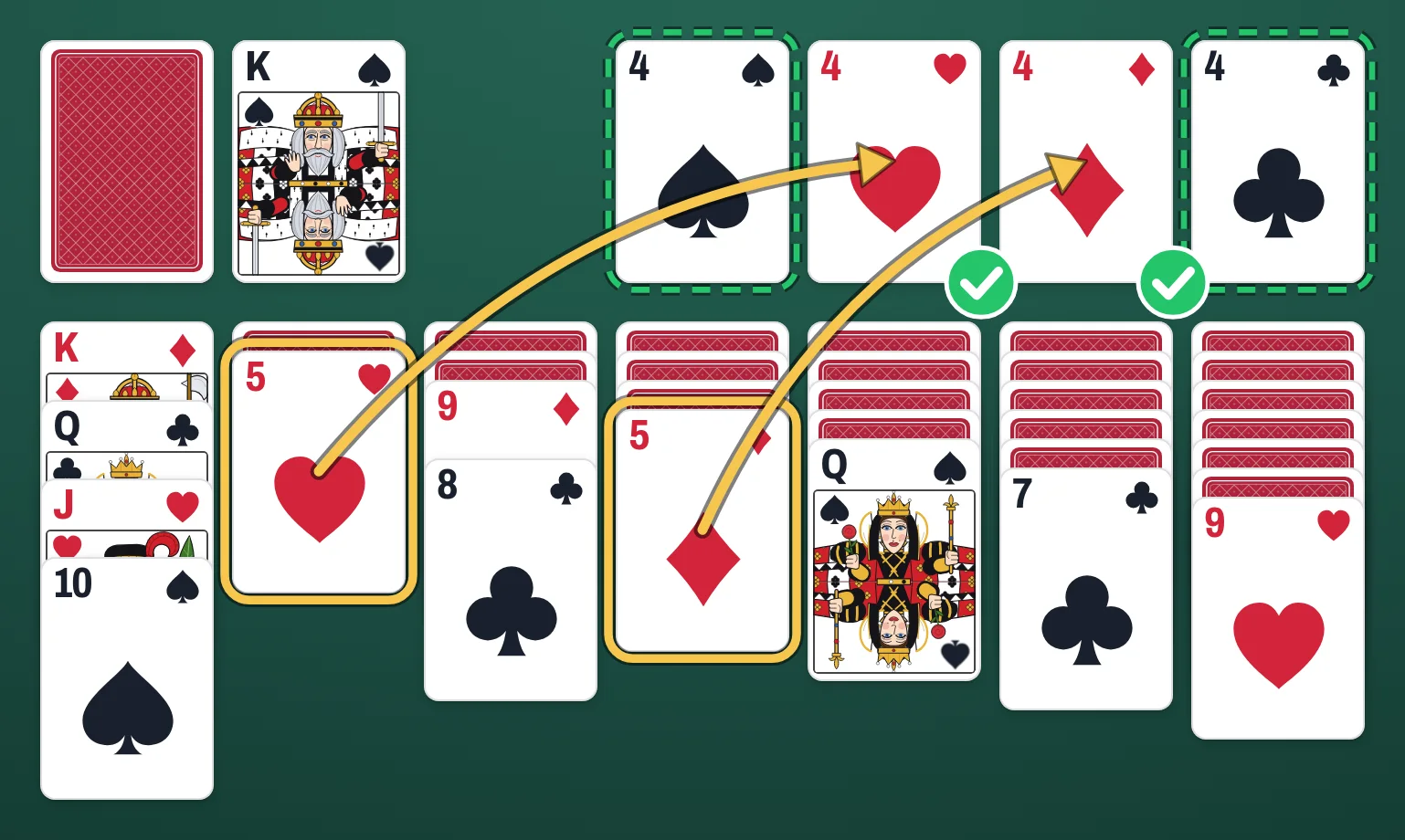
A card on a foundation can no longer hold other cards. A simple rule tells you when sending it up costs nothing: a card is safe on its foundation when both cards of the other color one rank lower are already on theirs.
Example: the clubs foundation reaches the 4♣ and the spades foundation the 4♠. Now the 5♥ and 5♦ are safe to send up, because no black 4 is left that might need a red 5 to stand on.
A card that isn’t yet safe may still be worth sending up when it turns over a hidden card or frees one you need. Just do it on purpose, not out of habit.
3. Work on the biggest pile of hidden cards
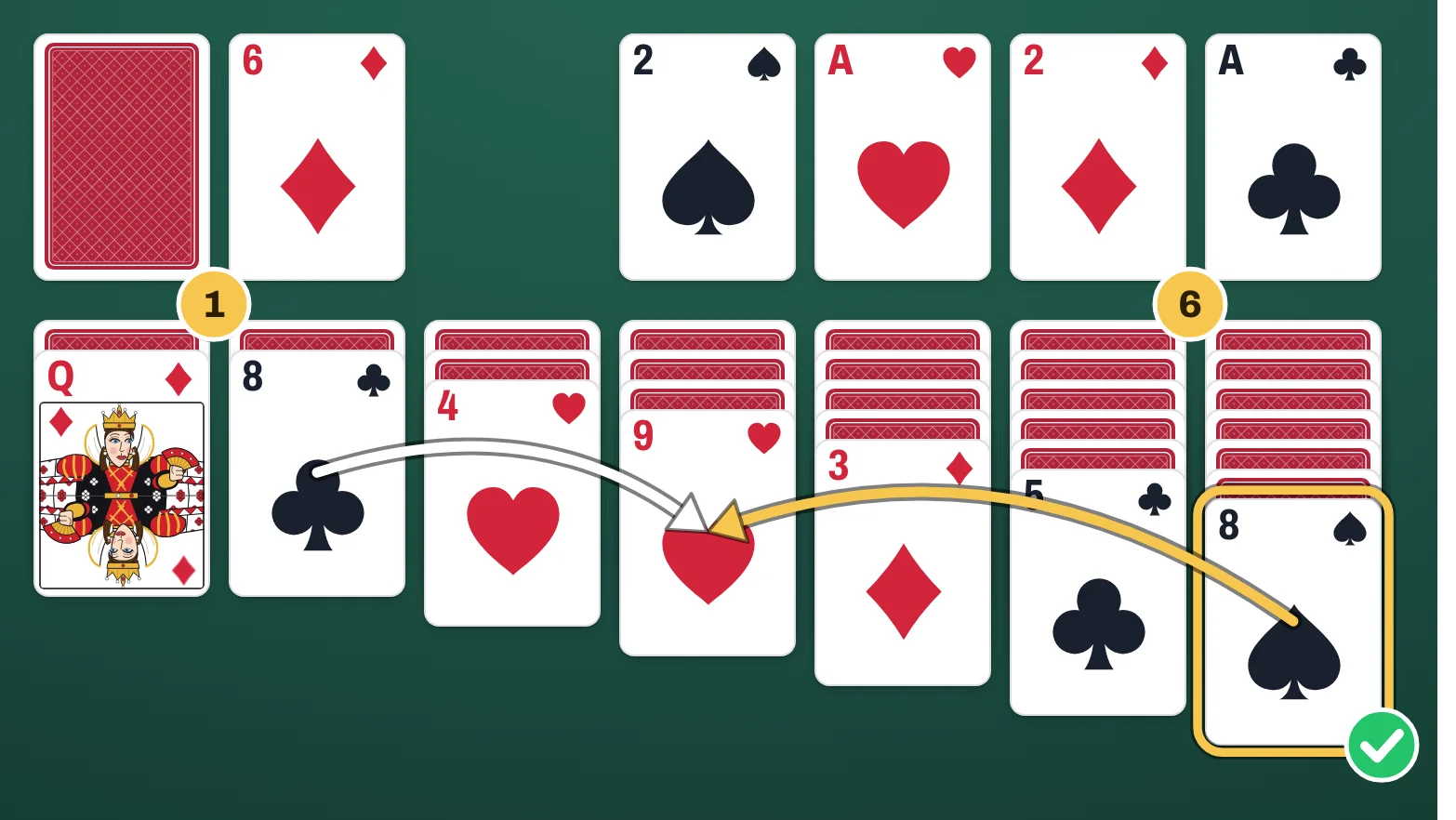
At the start, the rightmost column hides six cards and the leftmost none. Uncovering a big pile early opens the most new possibilities and gives you more time to use what you find. When two moves are otherwise equal, choose the one that works on the column with more face-down cards.
4. Plan your empty columns
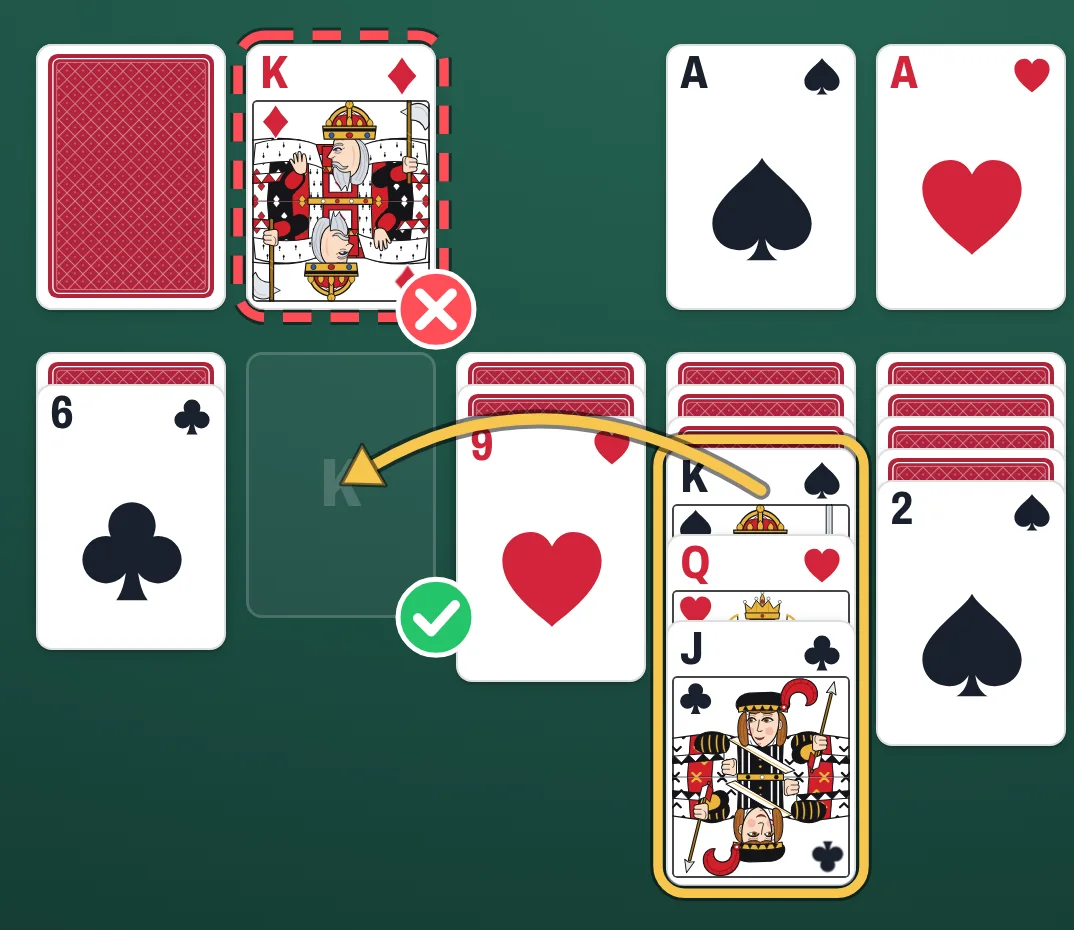
An empty column is the most powerful thing on the table, and it can only hold a King. Before you clear one, know which King will fill it. If you have the choice, keep the space until a King comes with useful cards: a King already holding a Queen and a Jack, or a King whose move turns over a hidden card. A King moved from a column where it covered no hidden cards only shifts the problem.
5. Choose the King by the cards you can see
If a red and a black King can both fill a space, look at the Queens. A red Queen you can already play goes on a black King, and a black Queen on a red King. Pick the King that the visible Queens and Jacks can build on, so the new column grows straight away.
6. Keep both colors in play
Builds need the colors to alternate, so a table full of red 8s with no black 9 to go on is stuck. When you have a choice of where to put a card, keep options open for both colors: don’t cover the only black 9 that a red 8 could use if another place will do.
7. Use the stock as a resource, not a reflex
Turn the stock when the columns offer nothing more. In Turn 1, use your first pass to see what the stock holds. In Turn 3, remember that each card you take from the waste changes which cards you’ll reach on the next pass, so think about which plays open new cards. Our article on Turn 1 and Turn 3 shows how the groups of three shift.
8. Take a card back from a foundation when it helps
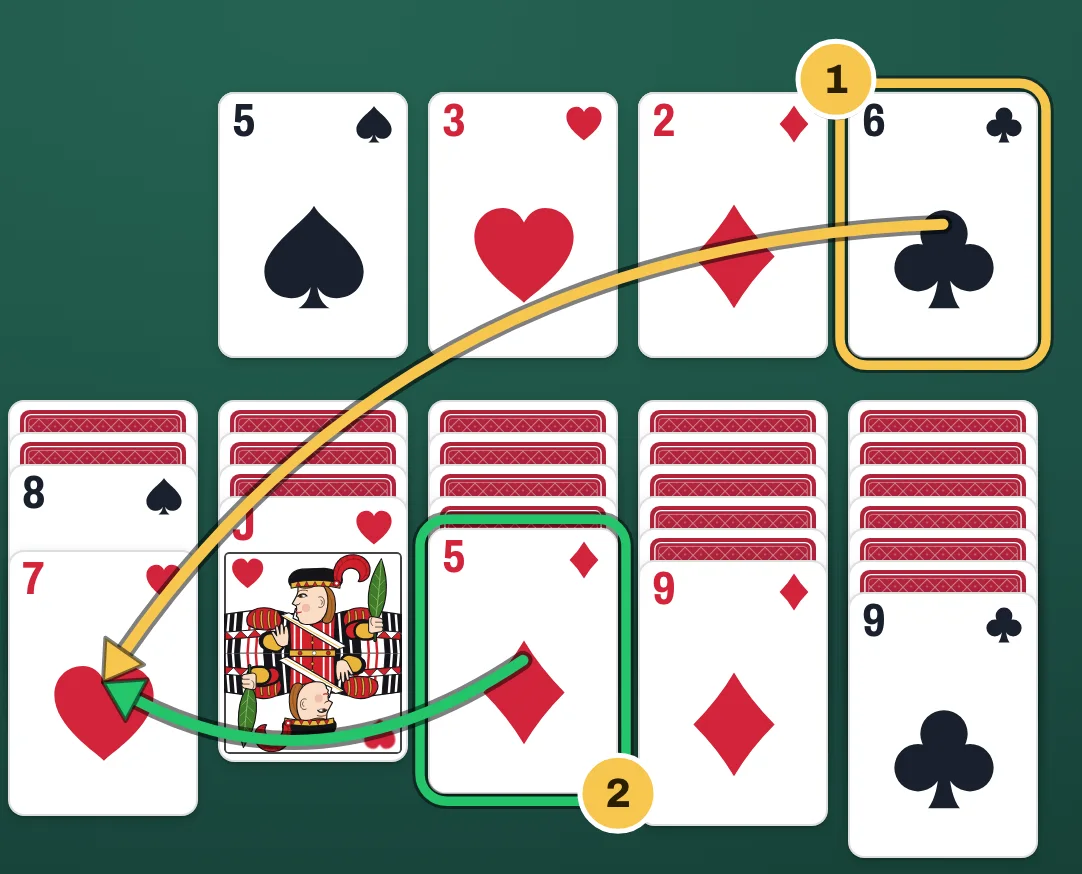
The rules let you move the top card of a foundation back down to a column. It costs 15 points, but it can save a game: bringing back a 6♣ can give a red 5 the place it needs, and that red 5 may be all that stands between you and a hidden card.
9. Explore with Undo, check with Hint
When a decision is close, try one line and see where it leads. If it goes nowhere, Undo back to the choice and try the other. Over a few games you’ll learn which kinds of moves pay off. If you’re stuck, Hint suggests a useful move, and if no useful move is left, the game tells you, so you never waste time on a lost position.
A quick checklist
- Aces and 2s up at once; other cards only when they’re safe or they help.
- Turn over hidden cards first, biggest piles first.
- Never empty a column without a King ready.
- Choose Kings by the Queens you can see.
- Columns before stock.
- Undo to explore.
The same thinking works in other games too. In Yukon there is no stock at all, so the columns are everything, and in FreeCell every card is face up, which makes planning ahead the whole game.